/

    System overview

    This satellite consists of a bus system necessary for basic operation and a mission system that carries out a mission. The bus system consists of seven subsystems and the mission system consists of four devices.The system diagram is shown below.This satellite does not have attitude control system. The thermal control system is equipped only with a heater that heats the battery.


    The outline of the bus system is as follows.

    Subsystem name Conposition and function
    Electrical Power Supply:EPS Components : Solar cell, battery, regulator, microcomputer, charge control IC, heater, switch
    It generates and charges, and supplies the stabilized power supply to the entire onboard equipment. Control the power consumption according to the capacity of the battery. In addition, switch various switches. Further, ON/OFF control of the heater is performed.
    Sensor Group:SG Components : temperature sensor, ammeter, geomagnetic sensor, gyro sensor, A/D converter, microcomputer
    Count satellite time. Also, measure battery voltage, current of solar cell, temperature of each equipment, satellite angular velocity, geomagnetism, and transmit measurement data along with satellite time to other subsystems.
    Command & Data Handling : C&DH Components : Modem, FEPROM, microcomputer, bus communication device
    Sensing data from SG, image data from CAM, electric field intensity data from TRP are processed and saved. Also, these data are generated as FM packets and output to the bus communication device.
    Continuous Wava:CW Components : microcomputer, bus communication device
    It receives HK data from another subsystem, converts it into CW beacon, and outputs it to the bus communication device.
    Flight Management Receiver:FMR Conponents : Modem, Switch, microcomputer, bus communication device
    It receives the uplink from the ground station and sends commands to each subsystem.
    Structure:STR Components : structure(including screw etc.), antenna, antenna deployment mechanism, separation detection switch
    Hold the mounted equipment so that it can withstand the launch load.
    Harness:HAR Connect internal devices such as wire harnesses.


    The outline of the mission system is as follows.

    Mission component Fuction
    π/4 shift QPSK transmitter : QPSK It receives data from C&DH, generates packets of CCSDS protocol, and transmits data to ground station with π/4 shift QPSK modulation.
    FSK transmitter : FSK It receives data from C&DH, generates packets of AX.25 protocol, and transmits data to ground station with FSK modulation.
    Linear transponder: TRP Relay audio data uplinked from the ground station to other ground stations in real time. Also, the electric field intensity is measured.
    Camera system : N-CAM Take an image, save the data, and send it to C&DH, QPSK.

    Bus system

    EPS(Electrical Power System)

    EPS is generates power with solar cell ,charging batteries and supplies stabilized power to the entire equipment,and at the same time responds to the capacity of the battery and controls power consumption. In addition, it switches various switching. Also, it performs on / off control of the heater. EPS system diagram is as follows.

    The main functions of EPS are as follows.

    1. Control of power consumption by battery capacity

    It automatically switches to the power mode shown below according to the battery capacity.It monitors the bus voltage and enters power saving mode when it reaches the preset threshold value or less. If the battery temperature is low, the threshold value higher than usual voltage. We can also change the threshold by uplink.In addition, if you want to operate with high power consumption for a long time, you can use the forced execution mode so that it does not enter save mode.

    Normal Mode ・Mode when power problem does not occur.
    Power saving mode ・ When supply power is lower than to power consumption and power is insufficient.
    ・Charging the battery by turning OFF the power supply except the minimum necessary equipment.
    ・Only in CW operation mode at power saving possible.
    Forced Mode ・Mode used when you want to control the satellite from the Earth station regardless of power problem.
    ・Operation in all operating modes is possible.

    2. Battery charge control

    In operation, if there is excessive charge from the solar battery to the battery, the battery may be deteriorated. Therefore, overcharge is prevented by the charge control IC. Also, even if the battery voltage becomes too low, it deteriorates, so protect the battery in the save mode so that the voltage will not be lower than expected.

    3. Heater control by battery thermal

    If the battery thermal is low, the battery capacity will be low. In addition, charging to a battery of 0 degree or less leads to deterioration of the battery. Therefore, when the temperature of the battery becomes 0 degree or less, control to automatically turn on the heater and actively increase the battery temperature is performed I will.

    4. Supply of stabilized power supply

    The voltage supplied from the battery and the solar cell is regulated to 5 v and 3.5 v by the regulator and supplied to each system. This satellite supply 5V for bus system and mission system camera system and 3.5V for mission communication machine.

    5. Power control of each system

    In accordance with the command, you can turn on / off the power of each system.

    6. 3 inhibit switch at launch

    Until the satellite is separated from the rocket, it must not affect the rocket or other satellites by satellite radio waves etc. Therefore, it is necessary to prevent the satellite from turning on during transportation. So, using the three separation detection switches, the power supply from the battery to the system is cut off and designed to prevent malfunction at launch.

    SG(Sensor Group)

    This system get data which need to monitor the conditions of voltage, current, temperature and so on. This system transmits these data to EPS(Electric Power Supply), CW(Continuous Wave), CAM(camera), CDH(Command & Data Handling). These data which transmits to EPS, CW, CAM are converted to physics quantity. On the other hand, these data which transmits to CDH are sent as without converting sensor data to physics quantity. The reason of this process is that the weight of process in EPS, CW, CAM are alleviated.

    System diagram of this system is shown as below.


    Contents of data

    Details of data which this system gets are shown as below.

    Voltage Buss voltage
    CurrentBuss current, solar cell current ×6
    Temp Battery ×2, 5V regulator_1, 5V regulator_2, 3.5V regulator, Nishi transmitter, Nishi receiver, QPSK transmitter, FSK transmitter, liner transponder, solar cell ×6, gyro sensor ×3
    Angular velocity3axis
    Geometric magnet3axis


Temperature sensor


Gyro sensor


Geometric magnet sensor


    C&DH(Command & Data Handling)

    It is a system that acquires and stores sensor data, etc., transmits the data to the ground station, and additionally manages operation of the mission equipment.
    The data acquired by NEXUS is roughly divided into three data, HK data, image data, electric field strength data, and all of which are saved in the C&DH system. It creates FM packets from the stored data and sends it to the ground station. It is also possible to send HK data in real time.


    In addition to FM packets, SSTV data and Digi-Talker voice data are transmitted to provide amateur radio operators the opportunity to train satellite communication technology. In addition, the system is responsible for the management of all mission equipment. It commands photography to the camera system, transmits data stored in C&DH to the mission transmitter and commands RF radiation.


    CW(Continuous Wave)

    This system transmits CW beacon. And contents of CW beacons are call sign, satellite name, satellite time, and sensing data like a battery voltage. This system has Normal Mode, Power Saving Mode, Custom Mode. Normal Mode is nominal operation. If power condition is danger, CW operation mode transit to Power Saving Mode automatically. When the power condition recovers, operation mode transit to Normal Mode automatically.

    System diagram is shown as below.


    Call signJS1YAV
    Satellite nameNEXUS

    Sending data

    Sending data which can transmit are shown as follow.
    Contets Data type Amount
    Satellite time int 4bytes
    Switch information int 1byte
    Reset information int 5bytes
    Battery voltage long 2bytes
    Battery current long 2bytes
    Battery temperature 1 long 2bytes
    Battery temperature 2 long 2bytes
    5V regulator temperature 1 long 2bytes
    5V regulator temperature 2 long 2bytes
    3.5V regulator temperature long 2bytes
    Power amplifier temperature of linear transponder temperature long 2bytes
    QPSK transmitter temperature long 2bytes
    FSK transmitter temperature long 2bytes
    Gyro data(x,y,z) long 6bytes
    Magnet data (x,y,z) long 6bytes
    SUM 42bytes


    Operation mode

    operation modes of CW system are shown as follow.
    Normal Mode: Nominal operation mode.
    Power Saving Mode: Transmit interval is 10 times of Normal Mode.
    Custom Mode : Sensing data can be selected as arbitrarily.

    FMR(Flight Management Receiver)

    FMR is the highest system of this satellite receiving uplink.It receives the uplink from the ground station and sends the command to each system according to the time. The system diagram is as follows.


    The main functions of FMR are as follows.

    1. Receives commands from the ground station and sends commands to each subsystem according to time

    The uplink contents transmitted from the earth station are composed of call sign, security byte, setting forced execution, execution time, command, remarks data. This system calculates security bytes based on the uplinked data. Then, it compares it with the security byte sent from the earth station and stores only the packet whose value matches in the command ROM. There is an execution time for each command, and when the execution time elapses from the time of receiving the uplink, a command corresponding to that time is transmitted to each system.

    2. Control of antenna deployment mechanism after rocket separation

    Antenna deployment of this satellite is done by cutting Dyneema which fixes the antenna. Dyneema can burn out with the heat generated at that time by applying current to the nichrome wire. In addition, the antenna is a total of four antennas for telemetry transmission and reception, and transmission and reception antenna for mission communication equipment.

    3. Control of latching relay

    After the operation is completed, if a radio wave comes out from the satellite, other satellites will be affected. Therefore, this satellite turns off the latching relay to disconnect the supply line from the solar battery cell to the battery, stop the operation of the satellite can. Latching relays can be controlled by uplink.

    4. Reset bus subsystem

    The uplink allows you to reset each subsystem (EPS, CW, SG, C&DH).


    STR(STRucture)


    NEXUS will be launched with multiple satellites. Therefore, in order not to affect the rocket and other satellites, the structural system must satisfy "environmental conditions at launch" and "interface conditions" on the rocket side. Based on the interface conditions from the rocket, we determine the structural elements such as dimensions and rigidity. Considering air bleeding and outgassing etc., we design carefully paying attention to each one of materials and properties. NEXUS inherits the know-how of SEEDS-II and SPROUT, has a battery box in the center, and consists of two panels and two trusses as the main structure.

    As can be seen from the figure NEXUS has a size of a cube of 10 cm on a side, while the inside of the satellite is very dense because it has four communication devices. Therefore, the equipment arrangement will be deeply involved in mass characteristics such as the center of gravity and thermal design.We mount the heavy mass in the vicinity of the battery box to bring the center of gravity closer to the center of the inertial coordinate system. Here we describe thermal design.
    Normally, the satellite must be designed so that the temperature of the onboard equipment can be kept within the allowable temperature range against the thermal environment from launch to the end of operation. Unlike the ground, satellites around the Earth are exposed to harsh temperature environments (100℃ or more to -100℃ or less). Therefore, it is necessary to give thermal consideration to mounted equipment and structure. NEXUS, as mentioned earlier, because the equipment is mounted densely, the pattern of equipment placement is limited. Among them, keeping the temperature of the battery, which can be said to be the life of the satellite, above 0℃ is of utmost importance. Therefore, by placing the batteries that have been adopted in the past in the center, surrounding them with communication equipment with relatively large heat generation, we adopt a form that protects the power supply function of the satellite. However, this time, as a result of the thermal analysis, it is predicted that the battery temperature will drop to near 0℃, so we will install two heaters in the form of sandwiching the battery and thermal protection against power supply function.


    Mission system

    QPSK(π/4 shift QPSK Transmitter)

    The π/4 Shift QPSK transmitter is capable of packet communication at 38400 bps, which is faster than the speed (1,200 bps, 9600 bps) which was conventionally mainstream in amateur satellite communications. Generally, lack of communication data becomes a problem when communication speed gets faster, but in order to solve this problem, CCSDS protocol with error correction code is adopted. After the software development is completed, it is scheduled to be uploaded to the homepage.


    The specifications of QPSK transmitter are shown below.

    Size 79.5×39.5×10.0 mm
    Weight 74.1 g
    Operating voltage 3.38〜3.5 V
    Current consumption (during transmission) 750 mA
    Transmission speed 38.4 kbps
    Modulation method π/4shift QPSK
    Transmission frequency 435.900 MHz
    Transmission power 0.3 W
    Communication protocol CCSDS
    Occupied bandwidth 30 kHz以下
    Operating temperature range -20〜60℃

    FSK(FSK Transmitter)

    FSK transmitter is one of the mission radio mounted on NEXUS. The biggest feature is that the communication speed is variable. Transmission speed is variable between 1200 and 19200 bps. If the communication environment is poor, you can lower the communication speed and reliably downlink, you can downlink a lot of data by increasing the communication speed in a good communication environment. Figure 1 shows an overview of the FSK transmitter.


    FSK transmitter is more efficient FM packet communication than communication system which was mainstream in conventional satellite communication. The specifications are shown below.

    Size 53.8×36.0×5.0 mm
    Weight 36 g
    Operating voltage 3.5 V
    Current consumption (during transmission) 750 mA
    Transmission speed 1.2〜19.2 kbps
    Modulation method FSK
    Transmission frequency 435.900 MHz
    Transmission power 0.4 W
    Communication protocol AX.25
    Occupied bandwidth 30 kHz以下
    Operating temperature range -10〜50℃


    TRP(Linear Transponder)

    The linear transponder is a communication device that converts the uplinked audio in the 145 MHz band to the 435 MHz band and downlinks it. Furthermore, it has a function to measure electric field intensity in the 145 MHz band. With this function, it is possible to investigate the noise situation in the 145 MHz band around the satellite. The appearance of the linear transponder is shown below.


    The basic specifications of the linear transponder are as follows.

    Size 80×80×10 mm
    Weight 150 g
    Operating voltage 3.5 V
    Current consumption (during transmission) 750 mA
    Transmission speed -
    Modulation method CW,SSB
    Transmission frequency UP : 145.900〜145.930 MHz
    DOWN : 435.880〜435.910 MHz
    Transmission power 0.5 W
    Communication protocol -
    Occupied bandwidth 30 kHz以下
    Operating temperature range -10〜50℃


    N-CAM

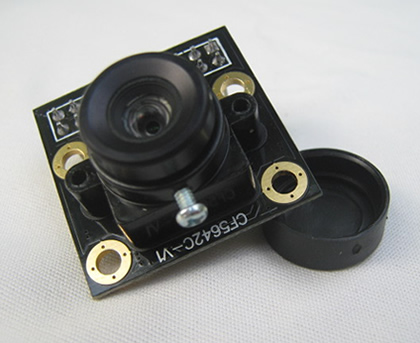
    The camera system(N-CAM) was developed in consideration of being mounted on a small satellite. It is possible to set various values for resolution, image format, and image effect while keeping the size and weight small.


    The system configuration and basic specifications of N-CAM are as follows.

    Parameters Min. Typ. Max. Units
    Image sensor OV5642 -
    Active array size 320×240 640×480 2592 × 1944 pixels
    Pixel size 1.4 × 1.4 μm
    Focal length 3 mm
    F ? number F/2.5 -
    Angle of view D 75,H 63,V 49 deg.
    Data formats JPEG BMP -
    Frame rate 16.88 fps
    Limit for continuous shooting 300 frame
    Power supply voltage 4.8 5 5.2 V
    Power consumption 600 mA
    System Control SPI,USART
    General-purpose port SPI,USART,GPIO
    Clock frequency(MPU) 72 MHz
    Memory
    FIFO(RAM)
    FEPROM
     
    16 MB
    32 MB
    Mechanical size
    Micro-controller board
    Camera module
    70 × 30 × 10 mm
    30 × 30 × 23 mm
     
    Temperature
    Operable range
    Stable operating range
     
    -30 70
    0 50

    N-CAM has four shooting mode, and shooting in various modes is possible depending on the application.

    No. Name of mode Functional overview
    1 shoot Shoot still images.Image format and resolution can be set.
    2 Movie shoot Shoot movies.In addition to being able to set the image format and resolution, it is possible to change the frame rate by another command(3.75~16.88fps).
    3 Continuous shoot Shoot the frame photography.In addition to being able to set the resolution and the number of shots, it is possible to adjust the top frame shooting interval(0.5~30s)
    4 Auto shoot Based on the angular velocity of the satellite, by automatically adjusting shutter interval, shoot evenly while the satellite rotates once.It is possible to adjust the resolution and the number of shot images.